


Rectangular Pipe
Tianjin Shenzhoutong Steel Pipe Co.,Ltd is a manufacturer and exporter dedicated to steel pipe industry. There are three main kinds of products in our factory--ERW Steel Pipes, Spiral Steel Pipes and Oil Casing Pipes. The products are widely used in petroleum, natural gas, gas, coal, machinery, electric power, piling and other purposes.
Accept ODM/OEM Services
All steel pipes produced by our company can be customized to meet the specific requirements of various industries and applications. The customization process begins with a thorough consultation between our technical experts and the client to ensure that all specific needs are addressed.
Production Equipment
Our company utilizes state-of-the-art international technological equipment, including W-FF molding, solid-state high-frequency induction welding, ultrasonic testing, and magnetic flux leakage detection. We also employ high-end testing equipment such as metallographic analysis instruments, Vickers hardness testers, impact testing machines, spectrum analyzers, and universal testing machines.
Honor Certificates
Since its establishment, our company has achieved numerous international certifications and honors, including API 5L, API 5CT, ISO 9001-2008, CE Certificate, pressure pipe production license, industrial products production license, Chinese petroleum and petrochemical membership card, China Quality Product Certification, Tianjin Famous Brand, exemption product, and recognition as one of the top 100 private enterprises in Tianjin.
Sales Market
Our products are exported to regions such as the Middle East, South America, North America, the European Union, and Southeast Asia. Over the years, we have earned an excellent reputation among customers worldwide.
-
![ASTM A500 GI Square Steel Tube]() ASTM A500 GI Square Steel TubeProducts Description ASTM A500 GI square steel tube is a composite structural profile formed by cold‑forming a North American ASTM A500 square hollow section (HSS) base and then applying a hot‑dip...read more
ASTM A500 GI Square Steel TubeProducts Description ASTM A500 GI square steel tube is a composite structural profile formed by cold‑forming a North American ASTM A500 square hollow section (HSS) base and then applying a hot‑dip...read more -
![Premium Quality Hollow Section Tube ERW Welded Black Hot Galvanized Rectangular Carbon Steel Square Tube For Building Material]() Premium Quality Hollow Section Tube ERW Welded Black Hot ...Carbon steel square tube application: widely used in engineering construction, glass curtain walls, door and window decoration, steel structure, guardrail, machinery manufacturing, automobile...read more
Premium Quality Hollow Section Tube ERW Welded Black Hot ...Carbon steel square tube application: widely used in engineering construction, glass curtain walls, door and window decoration, steel structure, guardrail, machinery manufacturing, automobile...read more -
![ASTM A106/A53 BS SHS Hot-Dip Galvanized Rectangular Steel Tube]() ASTM A106/A53 BS SHS Hot-Dip Galvanized Rectangular Steel...ASTM A106/A53 BS SHS Hot-Dip Galvanized Rectangular Steel Tube - Welded Hollow Steel Beams for Greenhouse Frames The reliability of a greenhouse frame is not just about "putting it together." It...read more
ASTM A106/A53 BS SHS Hot-Dip Galvanized Rectangular Steel...ASTM A106/A53 BS SHS Hot-Dip Galvanized Rectangular Steel Tube - Welded Hollow Steel Beams for Greenhouse Frames The reliability of a greenhouse frame is not just about "putting it together." It...read more -
![Galvanized Rectangular Hollow Steel Pipes]() Galvanized Rectangular Hollow Steel PipesProduct Overview Our hot-dip galvanized SHS rectangular hollow sections are engineered for long-life exposed structural applications, manufactured to ASTM A106, ASTM A53 and BS specifications....read more
Galvanized Rectangular Hollow Steel PipesProduct Overview Our hot-dip galvanized SHS rectangular hollow sections are engineered for long-life exposed structural applications, manufactured to ASTM A106, ASTM A53 and BS specifications....read more -
![1-inch Square Alloy Steel Pipe]() 1-inch Square Alloy Steel PipeProducts Description This 1-inch square alloy steel pipe is a high-precision industrial hollow square tube with a standard size of 1×1 inch (25.4mm×25.4mm). Manufactured in strict...read more
1-inch Square Alloy Steel PipeProducts Description This 1-inch square alloy steel pipe is a high-precision industrial hollow square tube with a standard size of 1×1 inch (25.4mm×25.4mm). Manufactured in strict...read more -
![ASTM A36 Structural Carbon Steel Square Tube]() ASTM A36 Structural Carbon Steel Square TubeProducts Description ASTM A36 structural carbon steel square tube (SHS Square Hollow Section) is manufactured in full compliance with ASTM A36/A36M specification for carbon structural steel. Both...read more
ASTM A36 Structural Carbon Steel Square TubeProducts Description ASTM A36 structural carbon steel square tube (SHS Square Hollow Section) is manufactured in full compliance with ASTM A36/A36M specification for carbon structural steel. Both...read more -
![ASTM Standard Galvanized Arc Welded Carbon Steel Square Pipe]() ASTM Standard Galvanized Arc Welded Carbon Steel Square PipePrecision Square Steel, Galvanized Endurance | A precise square shape defines industrial standard aesthetics, while rigorous craftsmanship underpins ultimate engineering safety and reliability....read more
ASTM Standard Galvanized Arc Welded Carbon Steel Square PipePrecision Square Steel, Galvanized Endurance | A precise square shape defines industrial standard aesthetics, while rigorous craftsmanship underpins ultimate engineering safety and reliability....read more -
![Seamless Carbon Steel Square Pipe Hollow Section Rectangular Steel Pipe And Tube]() Seamless Carbon Steel Square Pipe Hollow Section Rectangu...Products Description Square steel pipe (referred to as square tube) is a type of hollow square cross-section steel pipe material, which can be divided into multiple categories according to...read more
Seamless Carbon Steel Square Pipe Hollow Section Rectangu...Products Description Square steel pipe (referred to as square tube) is a type of hollow square cross-section steel pipe material, which can be divided into multiple categories according to...read more -
![75x38mm Hot-Dip Galvanized Rectangular Hollow Steel Tube]() 75x38mm Hot-Dip Galvanized Rectangular Hollow Steel Tube75x38mm Hot-Dip Galvanized Rectangular Hollow Steel Tube Product Overview Dimensions: 75mm (Width) × 38mm (Height) Material Grades: Q235B, S235JR, S275JR, GR.B, GR.C, STK400, STK500....read more
75x38mm Hot-Dip Galvanized Rectangular Hollow Steel Tube75x38mm Hot-Dip Galvanized Rectangular Hollow Steel Tube Product Overview Dimensions: 75mm (Width) × 38mm (Height) Material Grades: Q235B, S235JR, S275JR, GR.B, GR.C, STK400, STK500....read more -
![Rectangle Galvanized Steel Pipe]() Rectangle Galvanized Steel PipeProducts Description Product display Products application Packaging & Shippingread more
Rectangle Galvanized Steel PipeProducts Description Product display Products application Packaging & Shippingread more -
![ERW JIS Galvanized Square And Rectangular Steel Tubes]() ERW JIS Galvanized Square And Rectangular Steel TubesOur ERW JIS galvanized square and rectangular tubes are high-quality hollow sections manufactured by high-frequency Electric Resistance Welding (ERW) technology and finished with hot-dip...read more
ERW JIS Galvanized Square And Rectangular Steel TubesOur ERW JIS galvanized square and rectangular tubes are high-quality hollow sections manufactured by high-frequency Electric Resistance Welding (ERW) technology and finished with hot-dip...read more -
![Carbon ERW Steel Pipe Q235 Specification Ideal For Heavy-Duty Use]() Carbon ERW Steel Pipe Q235 Specification Ideal For Heavy-...Products Description Square pipe Galvanized square pipe is a hollow square steel pipe made from hot or cold rolled galvanized strip or coil. After cold bending and high-frequency welding, it forms...read more
Carbon ERW Steel Pipe Q235 Specification Ideal For Heavy-...Products Description Square pipe Galvanized square pipe is a hollow square steel pipe made from hot or cold rolled galvanized strip or coil. After cold bending and high-frequency welding, it forms...read more


|
Process |
Electrical Resistance Weld |
|
Standard |
ASTM A53,ASTM A500, EN 10210 ,EN 10219, JIS G 3466 ,BS 1387 |
|
Material |
GRB,GRC,S235JR,S275JR,STK400,STK500 |
|
O.D |
10*10-600*600MM |
|
W.T |
0.5-20MM |
|
Length |
As per customer's requirement |
|
Coating |
Oil.Galvanized coating |
Types of Rectangular Pipe

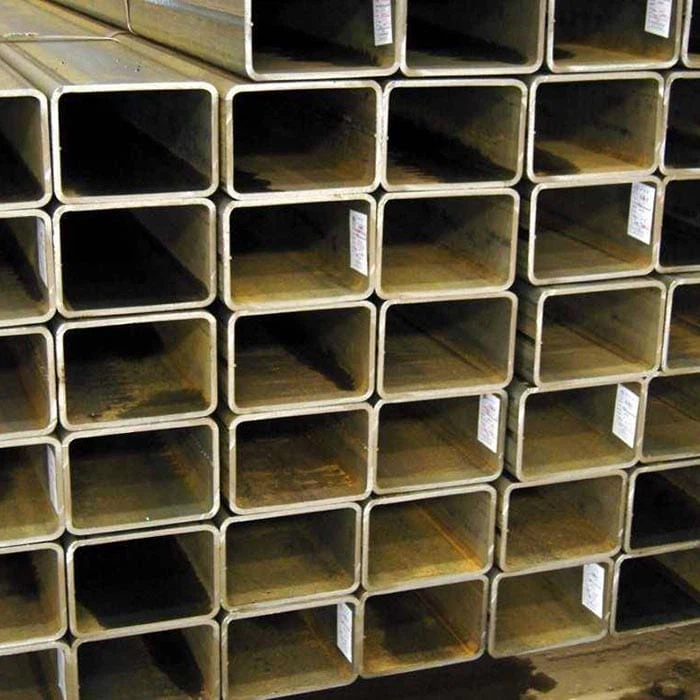


1. Mild Steel Rectangular Pipes:
Mild steel rectangular pipes are widely utilised in building projects because of their exceptional blend of durability and cost-efficiency. These pipes are commonly utilised in the construction of building frameworks, support structures, and various fabrication operations. Due to their exceptional weldability and high tensile strength, these materials are well-suited for various applications, including but not limited to fencing, railings, and pedestrian walkways.
Applications:
● Building frames and trusses
● Support columns and beams
● Fencing and barriers
● Pedestrian walkways and bridges
● Industrial machinery support structures
2. Stainless Steel Rectangular Pipes:
Stainless steel rectangular pipes are highly regarded in architectural and interior design projects due to their exceptional corrosion resistance and aesthetically pleasing look. These pipes provide a clean and timeless look, serving a wide range of purposes from contemporary balustrades and ornamental panels to kitchen equipment and outdoor installations.
Applications:
● Architectural designs and facades
● Interior and exterior railings
● Decorative panels and partitions
● Kitchen equipment and appliances
● Outdoor sculptures and installations
3. Galvanized Rectangular Pipes:
The galvanization process involves the application of a zinc coating onto rectangular pipes, thereby augmenting their ability to withstand corrosion. The utilisation of these pipes is crucial in outdoor scenarios where the potential for rust and degradation due to exposure to environmental elements exists. Galvanised rectangular pipes are commonly utilised in outdoor buildings, signage, and agricultural equipment.
Applications:
● Outdoor structures and canopies
● Signage and billboards
● Agricultural equipment and machinery
● Water supply systems in corrosive environments
● Greenhouses and garden structures
4. Structural Rectangular Pipes:
Structural rectangular pipes, which have been specifically designed to withstand substantial loads and resist stress, play a vital role in building and infrastructure endeavours. Structural engineers serve a crucial and indispensable role in the construction of frames, bridges, and industrial platforms, hence ensuring the overall safety and stability of expansive constructions.
Applications:
● Building frameworks and support columns
● Bridges and overpasses
● Industrial platforms and mezzanines
● Multi-story building structures
● Stadiums and event venues
5. Alloy Steel Rectangular Pipes:
Alloy steel rectangular pipes combine the inherent strength of steel with the distinctive characteristics imparted by alloying elements. These pipes are utilised in applications that require high strength, tolerance to extreme temperatures, and remarkable mechanical qualities. Critical components in various industries, including aerospace, automotive, and manufacturing, heavily depend on the utilisation of alloy steel rectangular pipes.
Applications:
● Aerospace components and structures
● Automotive chassis and frames
● High-temperature industrial equipment
● Manufacturing machinery and tooling
● Energy sector applications
6. Seamless Rectangular Pipes:
Seamless rectangular pipes, which are produced without the presence of welded seams, provide an enhanced inner surface quality and improved dimensional precision. These devices are well-suited for various applications that involve the movement of fluids, including pipelines and hydraulic systems. Seamless rectangular pipes are preferred in industries that prioritise cleanliness and sanitation, such as food processing and pharmaceuticals.
Applications:
● Fluid and gas pipelines
● Hydraulic systems and equipment
● Food processing and pharmaceutical machinery
● Chemical and petrochemical processing
● Cryogenic applications
7. ERW Rectangular Pipes:
Electric Resistance Welded (ERW) rectangular pipes are manufactured through the fusion of the edges of a flat steel sheet, thereby yielding a robust and economically viable solution. These materials are utilised in various applications that prioritise attributes such as durability and cost-effectiveness, such as in the fields of agriculture, automotive engineering, and building.
Applications:
● Agricultural machinery and equipment
● Automotive frames and components
● Construction scaffolding and supports
● Furniture and fixture manufacturing
● Plumbing and drainage systems
Surface Treatment Method of Rectangular Pipe
Pickling
This process involves the use of an acid solution, usually a mixture of nitric and hydrofluoric acid, to remove scales, oxides, and other impurities from the surface of the rectangular pipe. Pickling leaves the surface clean and corrosion-resistant.
Passivation
Passivation is the process of treating stainless steel with an oxidizing acid solution to remove any free iron from the surface and enhance the formation of a protective oxide layer. This helps in preventing corrosion and improves the overall corrosion resistance of the stainless steel.
Electropolishing
Electropolishing is an electrochemical process that removes a thin layer of material from the stainless steel surface, resulting in a smooth, shiny finish. This process not only improves the aesthetics but also enhances corrosion resistance by removing embedded contaminants.
Grinding and Polishing
Mechanical processes like grinding and polishing are used to achieve specific surface finishes on rectangular pipes. This can range from a coarse abrasive finish to a mirror-like polish, depending on the desired application.
Blasting
Rectangular pipes can undergo abrasive blasting using materials like glass beads, aluminum oxide, or stainless steel shot. This process removes surface contaminants and imparts a uniform matte finish.
Coating
Coating methods, such as painting or powder coating, can be applied to the surface of rectangular pipes for decorative purposes or to provide additional corrosion resistance. However, this is more common in non-industrial applications.
Heat Coloring
Controlled heating of the stainless steel surface can produce a range of colors through the formation of a thin oxide layer. This method is often used for decorative purposes and does not compromise the corrosion resistance of the material.
Pickling and Passivation Combined
Some processes combine pickling and passivation to achieve a comprehensive surface treatment that removes impurities and enhances the corrosion resistance of stainless steel.
Welding Style of Rectangular Pipe
Compression type
Insert the rectangular pipe into the nozzle of the pipe fitting and tighten it with a nut. Use spiral force to compress the casing at the nozzle through the sealing ring to act as a seal and complete the rectangular pipe connection. Scope of application: DN (nominal diameter) ≤ 150mm, can be installed in the open or concealed.
Welding type
Ring-shaped argon arc welding is performed on the usual socket-type pipe fittings and supporting parts to achieve a sealing effect and complete the supporting connection. Scope of application: Pipes in public buildings and large buildings, with DN between 15mm and 100mm. For DN greater than 100mm, conventional butt welding is the most common method; it can be installed exposed and concealed indoors, or buried outdoors.
Heat shrinkable pipe fittings
When connecting square pipes, on-site welding can be used. Since welding points cannot be processed at the construction site, heat-shrinkable pipe fittings are used for supplementary sealing. A rubber welding sleeve is put on the pipe welding point, and then a special cross-linked polyethylene sleeve is put on it, which shrinks under the action of heat, thereby achieving Shrink seal. Applicable scope: pipes with DN below 400mm.
Taper thread type
Annular argon arc welding is performed on the externally threaded sleeve and matching parts, and the internally threaded pipe fittings are connected with tapered threads for sealing to complete the matching connection. The applicable range is DN between 65mm and 100mm. It is suitable for pipes in public buildings and large buildings. It can be used in harsh environments such as foundation sinking, high temperature and high pressure.
Limit compression test
The square pipe adopts flange or port welding ring, and the connection method is a union or semi-union connection. After compressing the rubber sealing ring limit seal by 20%-30%, it enters the metal sealing groove and uses a limit seal to protect the sealing element. Joints can be made of copper or carbon steel. The applicable range is DN below 400mm, which is suitable for harsh environments such as foundation sinking and various types of high temperatures and pressures.
Quick connect flange type
Perform annular argon arc welding on the flange and matching parts, and use a quick clamp to compress the sealing gasket between the flanges to act as a seal and complete the matching connection. The applicable scope is DN 15mm-100mm, for pipes in public buildings and large buildings.
Union type quick connect flange
The traditional flange is turned into a union flange, the rectangular pipe port is flanged or welded, the ring is embedded in a groove, and a sealing rubber piece is placed in the groove, and the limit compression method is used to protect the sealing element. The applicable range is DN below 400mm and can be used as underground pipe.
1. For the place to be cut, wipe off the oil, debris or mud on the surface of the rectangular pipe with a rag or soft cloth.
2. Be sure to select special stainless steel cutting tools.
3. According to the construction drawing and the situation on site, use a ruler or other measuring tools to draw the cut position and mark the cut line.
4. When cutting, you need to fix it with a fixing tool such as a vise before cutting.
5. The cutting surface of the rectangular pipe should be kept round, and the cutting line should be at right angles to the axis of the rectangular pipe. Excessive force is the reason for cutting the rectangular pipe into a flat or ellipse, so the rectangular pipe should be cut with appropriate force.
6. The iron shavings and burrs on the cut surface should be completely removed with a file or a suitable tool to prevent the iron shavings and burrs from scratching the rubber o-ring and other accessories when they are inserted into the outer part of the joint.
Quality Inspection of Rectangular Pipe
Eddy current flaw detection
Eddy current testing is suitable for inspecting defects below the surface of rectangular pipes, and the depth generally does not exceed 6-7mm. There are two types of eddy current testing: the coil placement method and the through-coil method. If there are defects on the surface of the casting, the electrical characteristics of the eddy currents will be distorted, allowing the presence of defects to be detected.
Ray detection
Generally, X-rays or gamma rays are used as the radiation source, so radiation-generating equipment and other auxiliary facilities are required. When the rectangular pipe is placed in a radiation field, the radiation intensity of the radiation is affected by defects within the casting. The intensity of radiation emitted through the casting varies locally depending on the size and nature of the defect, forming a radiographic image of the defect, which can be visualized and recorded with radiographic film, or detected and observed in real time with a fluorescent screen, or detected with a radiation counter.
Liquid penetration
Liquid penetrant testing is used to inspect various opening defects on the surface of rectangular pipes. A commonly used penetration test is a coloring test, which involves soaking or spraying a colored liquid with high penetrating ability on the surface of the casting. The penetrant penetrates into open defects, the surface penetrant layer is quickly wiped off, and an easy-drying revealing agent is sprayed onto the casting surface.
Ultrasonic testing
During the propagation of the sound beam with high-frequency sound energy in the tube, it is reflected when it hits the inner surface or defects, thereby discovering defects. The amount of reflected sound energy is a function of the directionality and nature of the interior surface or defect and the acoustic impedance of such reflectors. Therefore, the sound energy reflected from various defects or internal surfaces can be used to detect the location of the defect, the wall thickness, or the depth of the defect below the surface.
Magnetic particle testing
It is suitable for detecting surface defects and defects several millimeters deep below the surface. DC magnetizing equipment and magnetic powder are required for testing operations. Magnetizing equipment is used to generate a magnetic field on the inner and outer surfaces of the casting, and magnetic powder or magnetic suspension is used to reveal defects. When the square tube generates a magnetic field within a certain range, defects in the magnetized area will generate a leakage magnetic field.
Shipment

Our Factory
Tianjin Shenzhoutong Steel Pipe Co.,Ltd ,with total investment of RMB 260 million, was founded in 2001 and occupied 86,000 square meters and building area 28,000 square meters. It is located in the Chinese Steel Pipes Base - Da qiu zhuang, Tianjin. 46 kilometers away from Tianjin Port and 3 km away from the high-speed exit, So the transportation is very convenient. More than 400 employees and over 70 Senior staff are working in the company.


Our Certificate


FAQ
As one of the most professional rectangular pipe manufacturers and suppliers in China, we're featured by quality products and good service. Please rest assured to buy high-grade rectangular pipe from our factory.
rectangular pipe seals, rectangular pipe, rectangular pipe connectors