

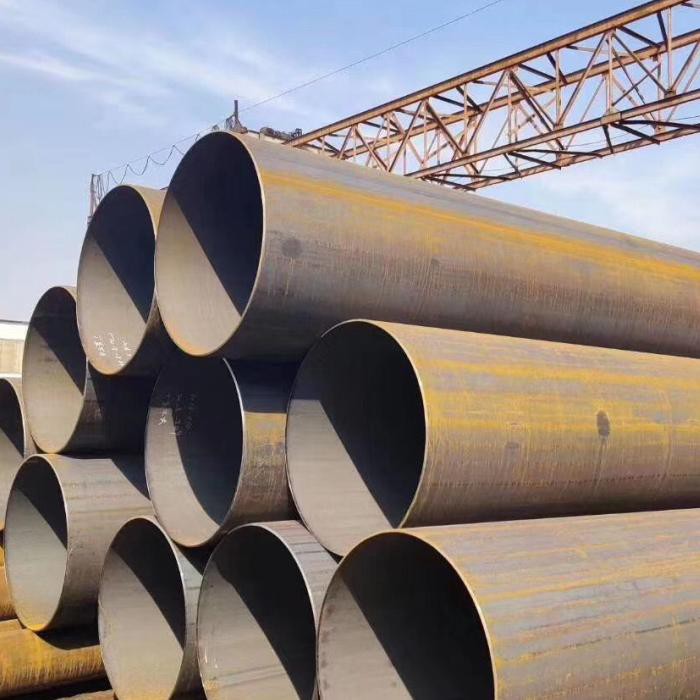
As a supplier of Longitudinally Submerged Arc Welded (LSAW) Line Pipe, ensuring the highest quality of our products is of utmost importance. Quality control measures are the backbone of our operations, guaranteeing that our LSAW Line Pipes meet or exceed industry standards. In this blog, I will delve into the various quality control measures we implement in the production of LSAW Line Pipe.

Raw Material Inspection
The quality of LSAW Line Pipe starts with the raw materials. We source our steel plates from reputable suppliers who have a proven track record of providing high - quality materials. Before the production process begins, a series of inspections are carried out on the steel plates. Chemical composition analysis is conducted to ensure that the steel meets the specified requirements. This analysis determines the amounts of elements such as carbon, manganese, sulfur, and phosphorus in the steel. Deviations in the chemical composition can significantly affect the mechanical properties of the final product.
We also perform mechanical property tests on the steel plates. Tensile tests are used to measure the strength and ductility of the steel. The yield strength, ultimate tensile strength, and elongation of the steel are determined through these tests. Impact tests are another crucial part of the mechanical property evaluation. These tests assess the ability of the steel to withstand sudden loading and dynamic forces. By ensuring that the steel plates have the right chemical composition and mechanical properties, we lay a solid foundation for the production of high - quality LSAW Line Pipe.
Manufacturing Process Control
The manufacturing process of LSAW Line Pipe is a complex one that requires strict control at every step. Plate cutting is the first step in the process. We use advanced cutting equipment to ensure precise dimensions of the steel plates. The cutting edges must be smooth and free from any defects such as cracks or burrs. Any irregularities in the cutting can lead to problems during the subsequent welding and forming processes.
Forming is the next critical step. The steel plates are formed into cylindrical shapes using either UOE (U - forming, O - forming, and Expanding) or JCOE (J - forming, C - forming, O - forming, and Expanding) processes. During the forming process, we closely monitor the shape and dimensions of the pipes. The roundness, straightness, and wall thickness of the pipes are continuously checked to ensure they meet the design specifications. Any deviations from the required dimensions can affect the performance of the pipes in actual applications.
Welding is perhaps the most crucial part of the LSAW Line Pipe manufacturing process. We use submerged arc welding, which offers high - quality welds with excellent strength and integrity. The welding parameters, such as welding current, voltage, and welding speed, are carefully controlled. We also conduct non - destructive testing (NDT) on the welds immediately after welding. Radiographic testing (RT) is used to detect internal defects in the welds such as porosity, lack of fusion, and cracks. Ultrasonic testing (UT) is another common NDT method that can detect both internal and surface - near defects in the welds. By ensuring the quality of the welds, we enhance the overall strength and reliability of the LSAW Line Pipe.
Finishing and Coating
After the welding process, the LSAW Line Pipes undergo finishing operations. These include end beveling, where the ends of the pipes are prepared for welding in the field. The bevel angle and dimensions must be precise to ensure proper welding connections. We also perform hydrostatic testing on the pipes. In hydrostatic testing, the pipes are filled with water and pressurized to a specified level for a certain period. This test helps to detect any leaks or weaknesses in the pipes. If a pipe fails the hydrostatic test, it is either repaired or rejected.
Coating is an important part of the finishing process. A protective coating is applied to the exterior and interior of the pipes to prevent corrosion. The type of coating used depends on the application and the environmental conditions in which the pipes will be used. We ensure that the coating is applied evenly and has the right thickness. The adhesion of the coating to the pipe surface is also tested to ensure its long - term effectiveness.
Final Inspection and Certification
Before the LSAW Line Pipes are shipped to our customers, a final inspection is carried out. This inspection includes a visual inspection of the pipes to check for any surface defects such as scratches, dents, or rust. The dimensions of the pipes are re - checked to ensure they are within the specified tolerances. We also review all the test reports and documentation related to the production process.
We are committed to meeting various international standards for LSAW Line Pipe. Our products comply with standards such as ASTM A252 Steel Pipe Casing [/lsaw - steel - pipe/astm - a252 - steel - pipe - casing.html], ASTM A672 Pipe [/lsaw - steel - pipe/astm - a672 - pipe.html], and ASTM A671 Pipe [/lsaw - steel - pipe/astm - a671 - pipe.html]. We provide our customers with detailed certification documents that confirm the quality and compliance of our products.
Importance of Quality Control
Implementing strict quality control measures is not only important for meeting industry standards but also for ensuring the safety and reliability of our products. LSAW Line Pipes are used in various critical applications such as oil and gas transportation, water supply, and structural support. Any failure of these pipes can have serious consequences, including environmental disasters, economic losses, and endangerment of human lives.
By providing high - quality LSAW Line Pipe, we build trust with our customers. Our reputation in the market is based on the consistent quality of our products. We understand that our customers rely on us to provide pipes that will perform well in their applications. Therefore, we are constantly investing in improving our quality control processes and technologies to meet the evolving needs of the industry.
Contact for Purchase and Negotiation
If you are in the market for high - quality LSAW Line Pipe, we invite you to contact us for purchase and negotiation. Our team of experts is ready to assist you in finding the right pipes for your specific requirements. We are committed to providing excellent customer service and will work closely with you to ensure that you get the best products at competitive prices. Whether you need pipes for a small - scale project or a large - scale industrial application, we have the capabilities to meet your needs.
References
- ASME Boiler and Pressure Vessel Code
- API (American Petroleum Institute) Standards
- ASTM (American Society for Testing and Materials) Standards